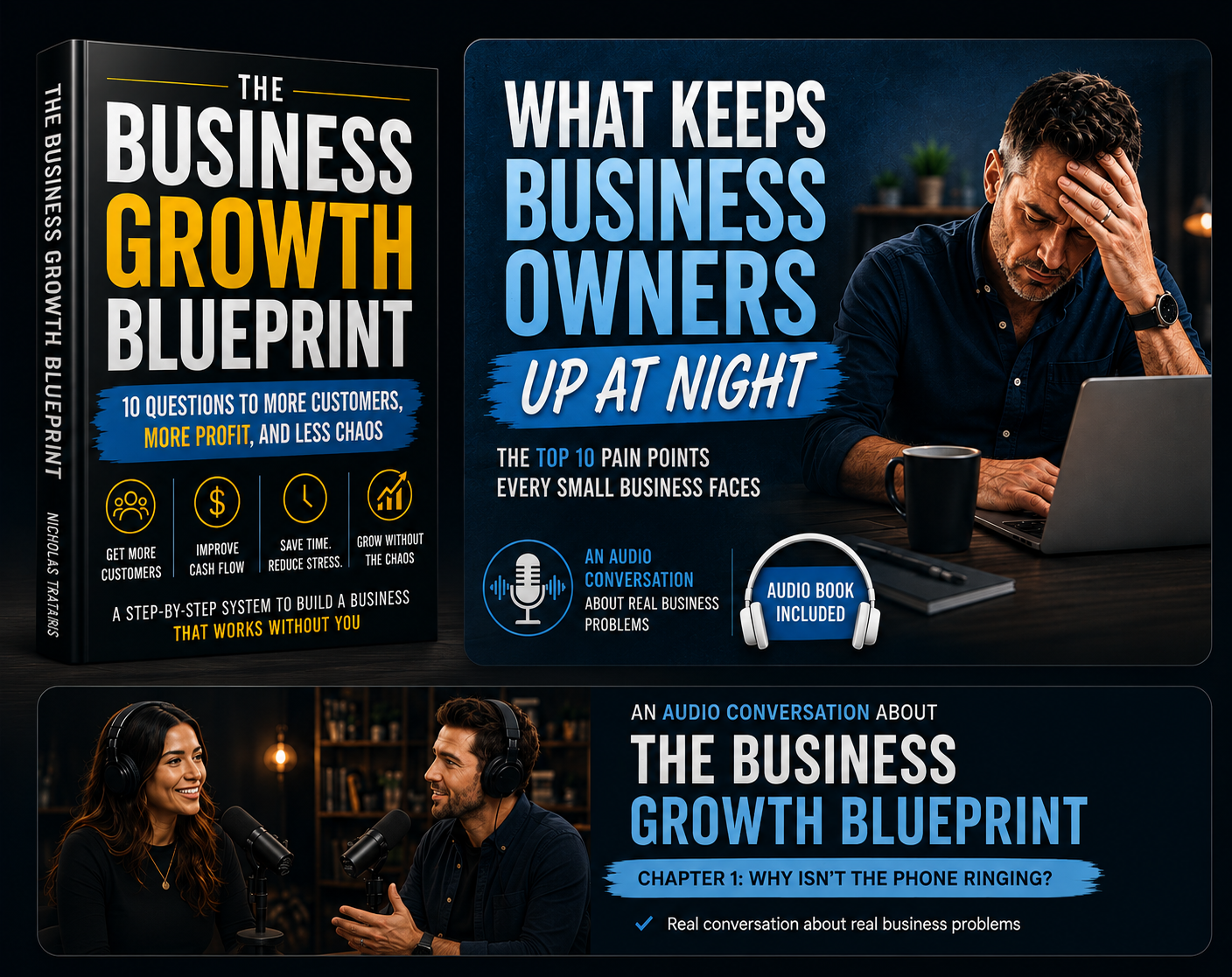
Turn Business Problems Into Predictable Growth
More customers, more profit, less stress. Diagnose the real constraint, fix the process, measure the result, then use IT, AI and automation where they actually help.
Chapter 1 + Chapter 2: From Fixing the Leak to Building the Machine
Chapter 1 diagnoses why qualified prospects are not contacting you. Chapter 2 turns that diagnosis into a repeatable customer-acquisition system.
Why Isn’t the Phone Ringing?
Find the leaks in the customer pipeline before spending more money to send traffic into a broken process.
How Do I Get More Customers?
Build a predictable customer-acquisition machine that attracts the right people, captures demand, follows up, converts and measures.
Chapter 1: Seven Reasons the Phone Isn’t Ringing
Not enough people know you exist
The right prospects are not discovering the business consistently.
You’re talking about yourself
Your marketing leads with your company story instead of the customer’s problem.
You’re reaching the wrong people
More traffic does not matter if the people arriving are a poor fit.
No compelling reason to act
Prospects need a clear, low-friction next step.
You’re losing leads you already have
Missed calls and slow responses quietly send business to competitors.
Nobody is following up
Old inquiries and former customers may be your fastest path to revenue.
You don’t know your numbers
Without lead-source, response-time and close-rate data, decisions become guesswork.
Chapter 2: The Customer Acquisition Machine
The goal is not random leads. The goal is a repeatable, measurable system that puts the right offer in front of the right people and improves from the numbers.
Hear the Blueprint Discussed, Not Just Read
Two conversational audio chapters are now available. Listen directly from the site.
Why Isn’t the Phone Ringing?
A practical discussion about why prospects are not contacting the business and what to fix first.
Lead PipelineResponse TimeFollow-UpHow Do I Get More Customers?
A discussion about building a repeatable customer-acquisition machine instead of relying on random marketing.
Ideal CustomerOfferAcquisitionMeasurementMeet Nicko Trataris
Nicko Trataris is the author of The Business Growth Blueprint. The book is built around practical questions business owners face when they want more customers, more profit and less stress. The approach starts with the business problem, then applies IT, AI and automation where they can produce measurable results.
Audit Chapters 1 and 2
Use the first audit to find leaks. Use the second to determine whether your customer-acquisition system is actually repeatable and measurable.
The 24-Hour Phone Ringing Audit
- Search Google for the problem your company solves. Can a prospect find you?
- Open your website on a phone. Within five seconds, is it obvious what you do and who you help?
- Submit an inquiry and start the clock. How long does it take to receive a useful response?
- Call the business. If nobody answers, what happens next?
- Leave a voicemail. Does anyone return it?
- Check whether anyone follows up tomorrow, three days later and a week later.
The Customer Acquisition Machine Audit
- Who is your highest-priority customer?
- What problem causes that customer to start looking for help?
- What outcome are they really buying?
- What proof makes your business believable?
- What is the simplest next step you want the prospect to take?
- Which channels match how customers search, learn and decide?
- Where is every lead captured, and who owns the response?
- What is your follow-up process?
- What percentage of qualified opportunities become customers?
- What does it cost to acquire a customer?
- Which stage of the acquisition machine is the biggest constraint right now?
Questions About the Business Growth Blueprint?
Contact us to discuss the book, the Business Growth Blueprint framework, or how IT, AI and automation can help solve specific business problems.
Diagnose. Fix. Measure. Grow.
Chapter 1 finds the leak. Chapter 2 builds the machine. Together they turn customer acquisition from guesswork into an operating system.
Listen to Chapters 1 & 2 →